
English version :
Project by Rémi Dauvergne, experimental filmmaker and visual artist.
Sound creation by Boris Allenou.
Remi Dauvergne’s Notes:
Shimmering surfaces have long been a constant source of inspiration for image practitioners. The myth of Narcissus aptly illustrates this fascination with the replication of reality, particularly on a mobile and variable surface.
After the concept of framing introduced by paintings, the idea of the backlit screen emerged. We transitioned into the electronic age and, similarly, from a graphical and photographic representation to a purely electro-graphical hybrid representation.
Despite its thinness, this device actually employs two entities to generate an image: a panel and a light source. The digital medium has caused the disappearance of technical phenomena that used to make us aware of their operations. These objects have become more impermeable and mystical, as we no longer perceive their internal workings. We now maintain a relationship with them similar to the one we’ve lost with our own bodies.
The shift from cinema to digital has also led to a loss of true black or, put differently, it must contend with black that is too translucent.
Intention:
For this setup, I chose to separate the panel of the screen from its light source. My intention is to restore the dimensions to each of these entities. The panel is a semi-transparent surface, a sieve of light, which provides shape and color, akin to film. However, the backlighting deprives us of complete black and homogenizes the light.
To regain true black and restore animated images to their former allure, I replaced the LED backlighting with a video projector. The pixel panel and the projector are enclosed in a darkroom to prevent any stray light and regain true contrast. To add more texture to the image, a handmade filter is installed behind the screen.
A film of shadows is projected onto the screen, while another film of highly contrasted textures illuminates it. Thus, synthesis is achieved by combining the two constituent entities of a screen.
Version Francaise :
Projet de Rémi Dauvergne, réalisateur de films expérimentaux et plasticien.
Création sonore : Boris Allenou.
Notes de Rémi Dauvergne :
Les surfaces miroitantes sont une source d’inspiration constante pour les praticiens de l’image. Le mythe de Narcisse illustre bien cette fascination pour la reproduction du réel, notamment sur une surface mobile et variable.
Après le concept de cadrage amené par le tableau est apparu celui de l’écran rétro-éclairé. Nous sommes passés à l’ère électronique et, d’une même façon, d’une représentation graphique et photographique à une représentation uniquement électro-graphique hybride.
Ce dispositif, malgré sa finesse, utilise en réalité deux entités pour générer une image : une dalle et une source lumineuse. Le support numérique a provoqué la disparition des phénomènes techniques qui nous rendaient sensibles leurs fonctionnements.
Ces objets deviennent plus imperméables et mystiques, car nous ne percevons plus leur fonctionnement interne. Nous entretenons avec eux un rapport semblable à celui que nous avons perdu avec notre propre corps.
Le passage du cinéma au numérique a par ailleurs induit une perte du noir ou, pour le dire autrement, il doit composer avec un noir trop peu opaque.
Intention :
Pour ce dispositif j’ai choisi de dissocier la dalle de l’écran de sa source lumineuse. Mon intention est de rendre à chacune de ces entités leurs dimensions. La dalle est une surface semi-transparente, une passoire à lumière, qui donne forme et couleur, c’est l’équivalent de la pellicule. Le problème est que le rétro éclairage nous prive d’un noir complet et homogénéise la lumière.
Pour retrouver un noir et refaire de l’image animée une réelle attraction, j’ai remplacé le rétro-éclairage LED par un projecteur vidéo. La dalle de pixels et le projecteur sont enfermés dans une chambre noire pour éviter toute lumière parasite et retrouver un vrai contraste. Pour donner un peu plus de texture à l’image un filtre artisanal est installé derrière l’écran.
Un film d’ombres diffusé dans l’écran, et un autre film de textures très contrastées vient éclairer le film.
La synthèse se fait donc en combinant les deux entités constitutives d’un écran.

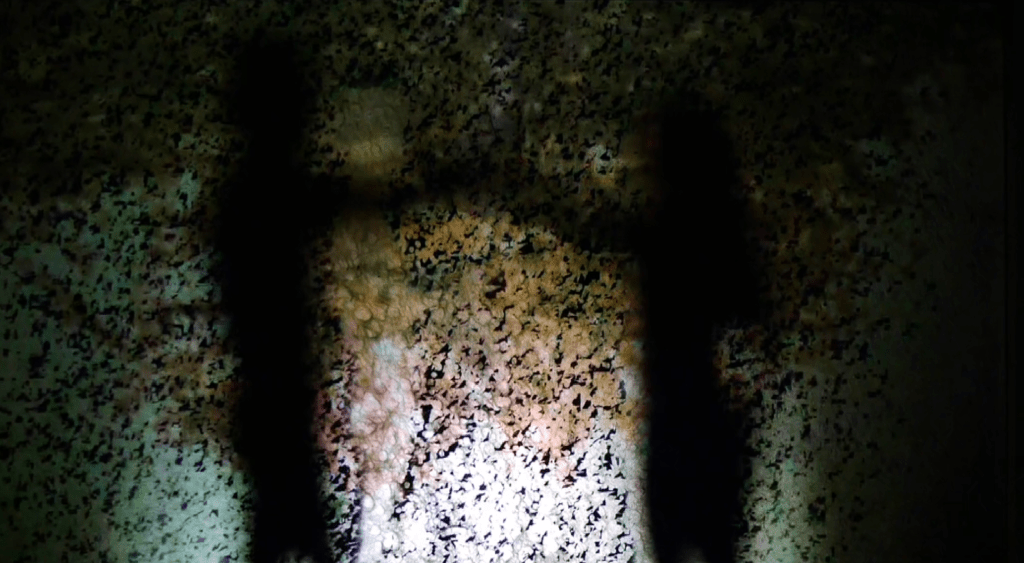

Derrière le Mythe de l’Ecran on Vimeo
 Boris Allenou